.png)
What Is Inflation and Why Do Some People Buy Crypto Because of It?
You have probably heard the word inflation in the news, maybe in conversations about rising prices at the supermarket, or in discussions about interest rates. But what does inflation actually mean, how does it work, and why do some people think buying cryptocurrency is a response to it?
These questions connect two worlds that might seem separate: traditional economics and the crypto market. Understanding this connection will help you think more clearly about one of the most commonly cited reasons people give for being interested in Bitcoin and other digital assets.
What Inflation Actually Is
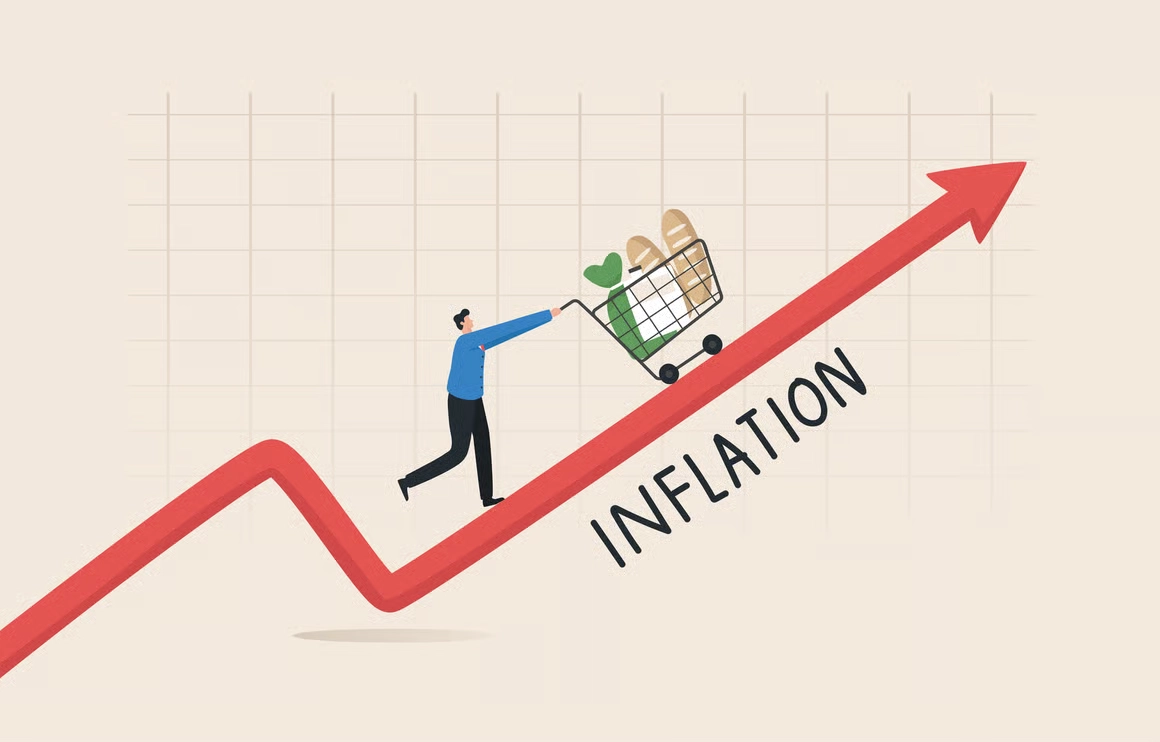
Inflation is when the general level of prices across an economy rises over time. When inflation is happening, the same amount of money buys you less than it used to. A bag of groceries that cost 50 pounds five years ago might cost 65 pounds today. Your money has not disappeared, but its purchasing power, what it can actually get you in the real world, has shrunk.
It is important to understand that a small, stable amount of inflation is generally considered normal and even desirable by most economists. When prices rise slowly and predictably, it encourages people to spend and invest rather than hoard cash, which keeps the economy moving. Central banks in most countries actually set explicit targets for inflation, typically around 2 percent per year, and use various tools to try to keep inflation close to that level.
The problem comes when inflation rises much higher than that, or when it becomes unpredictable. When prices rise quickly, the value of savings erodes rapidly. People on fixed incomes find their money buying less and less. Businesses find it hard to plan because they do not know what things will cost in six months' time. And if inflation gets completely out of control, a situation called hyperinflation, it can destroy an economy almost entirely, as seen in historical examples like Germany in the 1920s or Zimbabwe in the 2000s.
Where Does Inflation Come From?
Inflation has several causes, and they often overlap. Understanding the main ones is important for understanding why crypto has been positioned as a hedge against certain types of inflation.
Too much money in the economy is one cause. If the supply of money grows faster than the supply of goods and services, more money is chasing the same amount of stuff, and prices go up. This is where the connection to money creation becomes important.
Supply chain disruptions can cause inflation by making goods more expensive to produce and deliver. If oil prices spike, it costs more to transport everything, and those costs get passed on to consumers. If there is a shortage of a key material, products that depend on it become more expensive.
Strong demand can push prices up when people and businesses want to buy more than the economy can produce at current prices, causing sellers to raise their prices.
Expectations play a significant role too. If workers expect prices to rise and demand higher wages, and businesses respond by raising prices to cover their increased labour costs, inflation becomes self-reinforcing.
How Money Gets Created and Why It Matters
To understand the crypto angle, you need to understand a bit about how money is created in the modern financial system.
Most people assume that only governments print money, but in practice, the vast majority of money in circulation is created by commercial banks through lending. When a bank gives you a mortgage, it does not go to a vault and take out pre-existing money to lend you. It creates new money in the form of a credit to your account. This newly created money increases the total supply of money in the economy.
Central banks, like the Bank of England or the Federal Reserve in the United States, also create money through processes like quantitative easing. In this process, the central bank essentially creates new money digitally and uses it to buy assets like government bonds. This increases the total money supply and was used extensively during and after the 2008 financial crisis and again during the COVID-19 pandemic.
The concern raised by critics of this system, and it is a legitimate one, is that when the money supply expands significantly, the purchasing power of each individual unit of currency tends to fall over time. The money that existed before the expansion can now buy a smaller share of the total pool of goods and services. This dilution of value is sometimes described as a hidden tax on savings.
Why Some People Turn to Bitcoin as a Response
This is where Bitcoin's design becomes relevant to the inflation conversation. Bitcoin's supply is fixed at 21 million coins, and the rate at which new coins are created decreases predictably over time through the halving mechanism. Nobody can decide to create more Bitcoin. No government can order it, no central bank can implement it, and no corporate decision can change it. The supply is governed by mathematics, not by human institutions.
For people who are concerned about the long-term effects of money supply expansion on the purchasing power of traditional currencies, this fixed supply is appealing. The argument goes: if the supply of dollars or pounds keeps growing while the supply of Bitcoin stays fixed, then over time, Bitcoin should be able to purchase more dollars or pounds than it could before, simply by virtue of scarcity.
This is the logic behind calling Bitcoin "digital gold." Gold has historically been used as a store of value and a hedge against inflation partly because its supply grows very slowly and cannot be expanded at will. Bitcoin's fixed supply offers an even more radical version of this scarcity, one that is mathematically guaranteed rather than dependent on the physical difficulty of mining more gold.
Does It Actually Work That Way in Practice?
This is where the theory meets reality, and the answer is more complicated than Bitcoin's advocates sometimes suggest.
Looking at shorter time periods, Bitcoin has not behaved like a reliable inflation hedge at all. During the inflationary period of 2021 and 2022, when consumer price inflation in many Western countries hit multi-decade highs, Bitcoin's price actually fell dramatically. Rather than rising as inflation rose, Bitcoin declined sharply. This is the opposite of what a good inflation hedge is supposed to do.
What Bitcoin's price has actually correlated with in the short to medium term is much closer to risk appetite in financial markets. When investors are feeling confident and willing to take risks, Bitcoin tends to rise. When fear enters markets and investors move toward safer assets, Bitcoin tends to fall, often more sharply than stocks. This pattern looks much more like a speculative asset than an inflation hedge.
Supporters of the long-term inflation hedge argument would say that the relevant time frame is decades, not months or years. Over a long enough horizon, the argument is that the fixed supply will matter more than short-term market sentiment. But this requires believing that Bitcoin will still be widely valued in twenty or thirty years, that the fixed supply will be maintained, and that demand will continue to grow. These are genuine uncertainties, not certainties.
Other Crypto Assets and Inflation
Bitcoin is unique in having a hard supply cap, and this is important to acknowledge when discussing crypto and inflation. Many other crypto assets do not have fixed supplies. Ethereum, for example, does not have a hard cap on the total amount of Ether that can exist, although changes made to its protocol have made it so that Ether is sometimes being destroyed faster than it is being created.
Other tokens have been created with inflationary supply schedules built in, where new tokens are continuously created to reward participants in the network. If the demand for such tokens does not keep up with the supply, their value can fall even while traditional currencies are also losing purchasing power. Buying an inflationary crypto asset as a hedge against inflation in traditional currencies is not a coherent strategy.
For the inflation hedge argument to have any merit in the crypto context, it applies primarily to Bitcoin specifically, and even then with significant caveats about time horizon, volatility, and genuine uncertainty about the long-term future.
What This Means If You Are Thinking About It
If you have heard that crypto is a good way to protect yourself from inflation and you are considering acting on that idea, here are the honest things to keep in mind.
Bitcoin's fixed supply is a real feature of real design significance. The theoretical argument that a fixed-supply asset should hold its value better than an inflating currency over the very long term is coherent and is taken seriously by many thoughtful people.
However, the short-term volatility of Bitcoin is enormous and dramatically exceeds any inflation you are likely to experience in your savings. If you buy Bitcoin as an inflation hedge and the price falls 50 percent in the following year, you have lost purchasing power far more rapidly than inflation alone would have caused. The hedge works, if it works at all, only over very long time horizons, and it requires an ability to tolerate extraordinary volatility in the interim.
The appropriate weight to give Bitcoin or any other crypto asset in a financial plan is something that depends entirely on your personal circumstances, your time horizon, your understanding of the risks, and your ability to absorb losses without it affecting your financial stability or wellbeing. The advice here is not to dismiss the inflation hedge argument, but to engage with it honestly and critically rather than treating it as a settled fact.
Conclusion
Inflation is the gradual erosion of money's purchasing power over time, caused by factors including an expanding money supply, supply disruptions, and rising demand. Bitcoin's fixed supply has led many people to view it as a potential hedge against inflation, drawing comparisons to gold. The theoretical argument has logical coherence: a fixed-supply asset should not be diluted the way a currency with an expanding supply can be.
In practice, Bitcoin has not reliably behaved as a short-term inflation hedge, and its volatility is far greater than the inflation rates it is meant to protect against. The inflation hedge argument is most plausible over very long time horizons and requires substantial uncertainty to be accepted. Understanding both the argument and its limitations puts you in a much stronger position to think clearly about what role, if any, crypto might play in how you think about protecting the value of your savings.
.webp)
.webp)
.webp)